Net zero & environment
We will be net zero in our value chain.
Our goal is to have net zero emissions in our value chain. This includes the impact of our products and equipment in use. We have set science-based targets for reducing greenhouse gas (GHG) emissions, which have been validated by the Science Based Targets initiative (SBTi) in 2023:
- Reduction of absolute scope 1 and 2 GHG emissions by 50%, and absolute scope 3 emissions by 30%, by 2030 (baseline 2019).
- Reduction of absolute scope 1 and 2 GHG emissions by 90% by 2040.
- Net-zero GHG emissions, scopes 1, 2 and 3, by 2050.
The majority of our emissions are in our value chain, with nearly 70% coming from the use of sold products. Accelerating the development of more sustainable solutions to reduce the emissions of our customers is crucial.
Progress during the last years
From 2023 onwards we measure our climate targets with 2019 as the base year. This is more ambitious than previous target since we 2022 measured our targets against average 2016–2018 as the baseline.
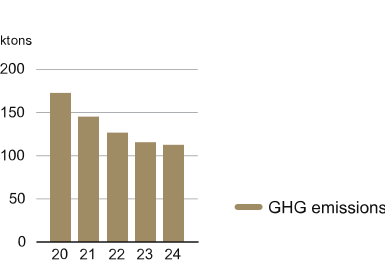
In 2024, we reduced our GHG emissions by 3 percent (comparable data). Compared to the base year 2019, GHG emissions have been reduced by 47 percent and we are on track to reach the 2030 target.
| 2019 | 2020 | 2021 | 2022 | 2023 | 2024 |
|---|---|---|---|---|---|
| 211 | 173 | 145 | 127 | 116 | 113 |
Environmental footprint
In our annual report, you can read about our environmental footprint and progress against the targets.
Go to the note for our environmental footprint in the annual report
Contribute to zero impact mining
We are developing solutions across all our industries. The mining sector of our business is a particular focus area as it accounts for a large percentage of our downstream emissions. As the world works to meet the targets of the Paris Agreement, there will be increased demand for the critical minerals needed to build the infrastructure for the energy transition.
Our ambition is for our equipment to contribute to zero impact mining of these minerals. Sustainable solutions for our mining equipment include battery-electric vehicles powered by fossil-free energy and energy-efficient rock processing solutions. We also offer productivity-enhancing manufacturing and machining solutions, optimizing energy and resource efficiency.
Working with our suppliers
Approximately a fifth of our emissions are from our suppliers. We work closely with them to identify ways to reduce emissions and we recommend they set science-based targets.
In our operations, our focus is on energy efficiency, switching to fossil-free energy and reducing emissions from internal transportation. We are working to ensure that every individual site has an action plan to reduce GHG emissions and increase energy efficiency.
Transition plan to net zero
Sandvik has made a long-term commitment to address climate change by setting science-based targets consistent with the Science Based Targets initiative (SBTi).
GHG reduction targets and decarbonization levers
Our transition plan for climate change mitigation outlines our key levers to reach our GHG emission reduction targets. Our GHG emission reduction targets and their compatibility with the limiting of global warming to 1.5°C in line with the Paris Agreement are further disclosed within E1-4.
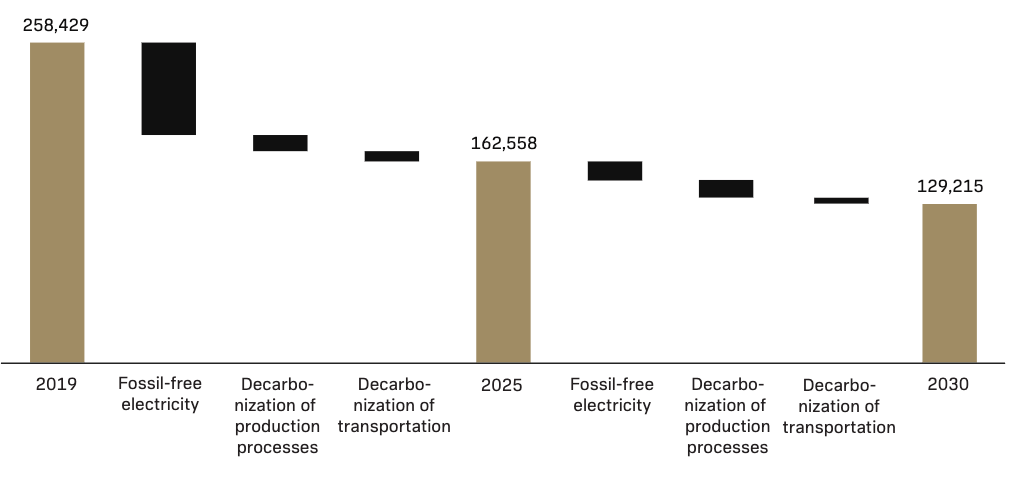
For own operations, we see efficiency measures and usage of fossil-free energy as key enablers for reducing GHG emissions. We approach our scope 1 and 2 emissions through the lens of transportation, production processes, and electricity usage. Our waterfall diagram on scope 1 and 2 reduction is based on these decarbonization levers.
About 65 percent of our value chain emissions are tied to the usage of our sold mining and rock processing products. Reducing these downstream emissions by developing solutions that reduce tailpipe emissions is a key priority. Applicable solutions include, for example, efficiency measures, and engines running on renewable fuels and electrification. In the upstream value chain, initiatives targeting resource efficiency, circularity, and purchasing goods with less embedded GHG emissions are key enablers for reducing GHG emissions. Uncertainties remain however, particularly regarding further developments in the fuel and electricity market, and customer preferences. These external factors are critical for achieving our long-term climate targets. The high degree of dependencies surrounding upstream and downstream emissions makes the mapping of a robust reduction pathway complex. However, we know our emissions hotspots and our focus lies on collaborating with suppliers and customers to reduce emissions. By developing and offering electrified mining and rock processing equipment that enhances customer productivity and profitability, we provide products that enable net zero within the industries that we serve.
The following table discloses our decarbonization levers and how GHG reduction is enabled.
|
Scope |
Decarbonization lever |
GHG reduction enabled by |
|---|---|---|
|
Scope 1 |
Decarbonization of transportation |
Efficiency measures, renewable fuels, electrification |
|
Scope 1 |
Decarbonization of production processes |
Efficiency measures, renewable fuels, electrification |
|
Scope 2 |
Fossil-free electricity |
Efficiency measures, fossil free-electricity |
|
Scope 3 |
Supply chain decarbonization |
Efficiency measures, recycled materials, increased circularity, low-carbon materials, new materials |
|
Scope 3 |
Decarbonization of transportation and distribution |
Efficiency measures, renewable fuels, electrification |
|
Scope 3 |
Decarbonization of product use phase |
Efficiency and productivity measures, R&D, electrification, renewable fuels, electric grid decarbonization |
The waterfall diagram below indicates how we aim to reduce our scope 1 and 2 emissions to 2030 and reach our related reduction targets.
Scope 1 and 2 roadmap to 2030, ton CO2eq (Market based)